AI Strategy Consulting Explained
Learn how AI strategy consulting works, from audit to launch, and how to vet a partner using CARCH Solutions' four-phase engagement model.
 Carlos Charria · Founder & CEO
 Every vendor pitch promises AI will transform your business, but almost none of them explain how to actually get there without wasting six months and a chunk of your budget. That gap is exactly what ai strategy consulting is supposed to close, and it’s why so many owners search for it right before they’re about to make an expensive mistake.
In plain terms, ai strategy consulting services help you figure out which parts of your operation are worth automating, in what order, and with what technology, based on your actual data and workflows instead of a generic tech trend. A good consultant maps your repetitive tasks, missed calls, or messy CRM data to specific AI tools, then builds a prioritized roadmap with measurable outcomes like hours saved or leads captured.
This article breaks down what these engagements typically include, how a structured discovery process should work, and what separates a consultant who delivers real ROI from one selling buzzwords. If you’re an operator trying to evaluate firms or build a business case internally, you’ll leave with a clear picture of what to expect and what to ask for.
Why AI strategy consulting matters for growing businesses
Most small and mid-sized businesses don’t fail at AI because the technology doesn’t work. They fail because they buy a chatbot or automation tool without first mapping it to a real bottleneck. AI strategy consulting exists to prevent that mismatch by forcing a business to answer a harder question before spending a dollar: which problem, measured in hours or dollars, are we actually trying to solve? Owners who skip this step often end up with three disconnected tools, a confused staff, and no measurable change in revenue or capacity.
The real cost of guessing
Guessing is expensive in ways that don’t show up on an invoice. A logistics company that automates dispatch scheduling before fixing its dirty CRM data just automates chaos faster. A home services business that adds an AI chatbot to a website that gets ten visitors a month is solving the wrong problem entirely. Strategy consulting catches these mismatches early by auditing workflows, call volume, lead sources, and staff time before recommending anything. That audit alone often reveals more wasted hours than owners expect.
The businesses that win with AI aren’t the ones that move first, they’re the ones that automate the right process first.
Competitive pressure is accelerating
Professional services firms, retailers, and trade businesses are all watching competitors answer calls at midnight, respond to leads in under a minute, and run marketing with a fraction of the staff. That pressure pushes owners toward AI adoption faster than they can evaluate it safely. A structured strategy engagement slows that down just enough to prioritize correctly, sequencing quick wins, like a 24/7 AI answering service that captures after-hours calls, ahead of more complex builds like custom agent development.
Internal capacity is usually the real constraint
Small and mid-sized teams rarely have a dedicated technical staff to evaluate AI vendors, integrate tools, or measure results honestly, which is why the hire in-house or partner with an agency question comes up so early. Leadership ends up making six-figure decisions based on demo videos and sales calls. Bringing in strategy expertise, even for a short engagement, replaces that guesswork with a prioritized roadmap built around the business’s actual data, staff bandwidth, and growth goals, not a vendor’s product roadmap.
How AI strategy consulting works, step by step
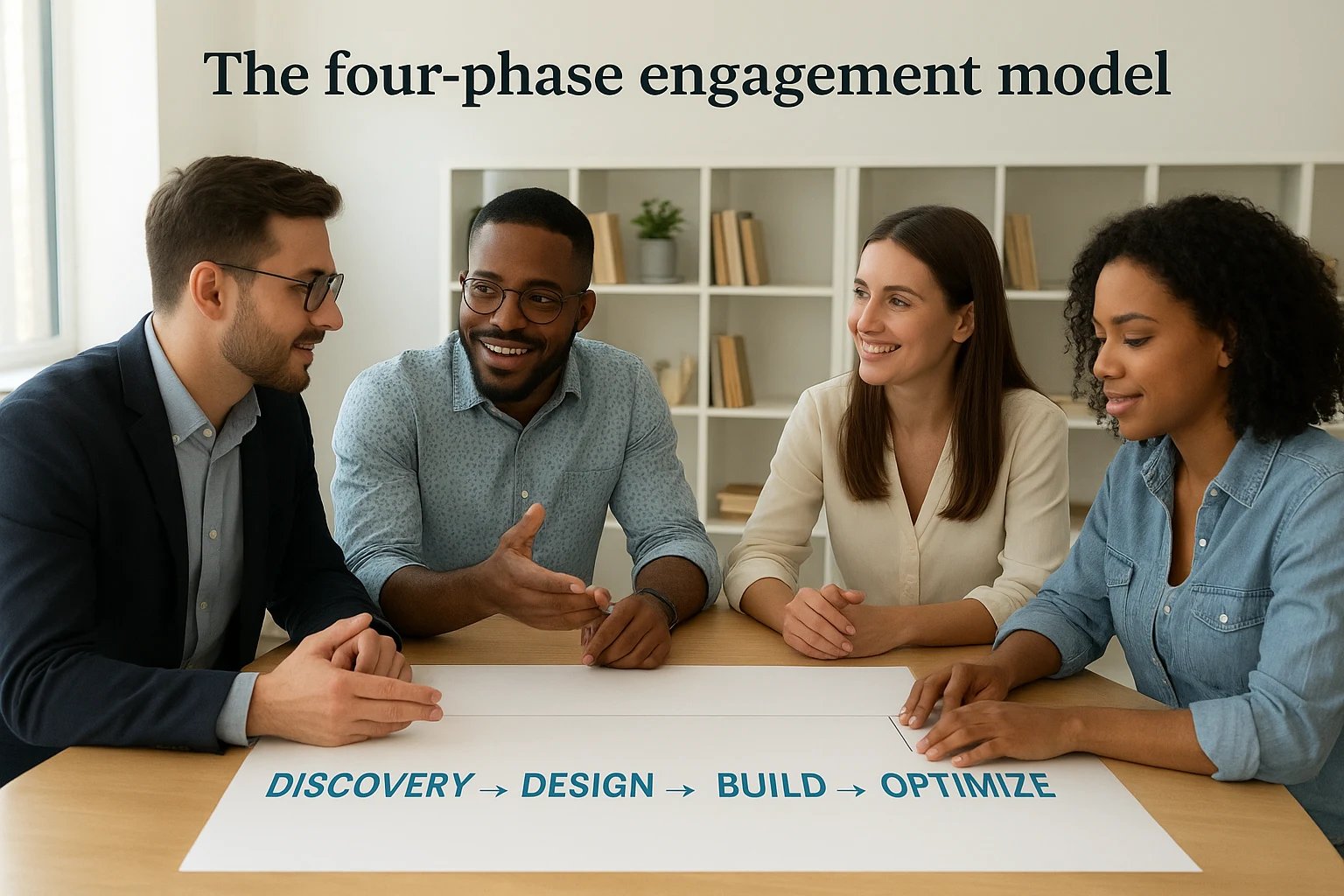
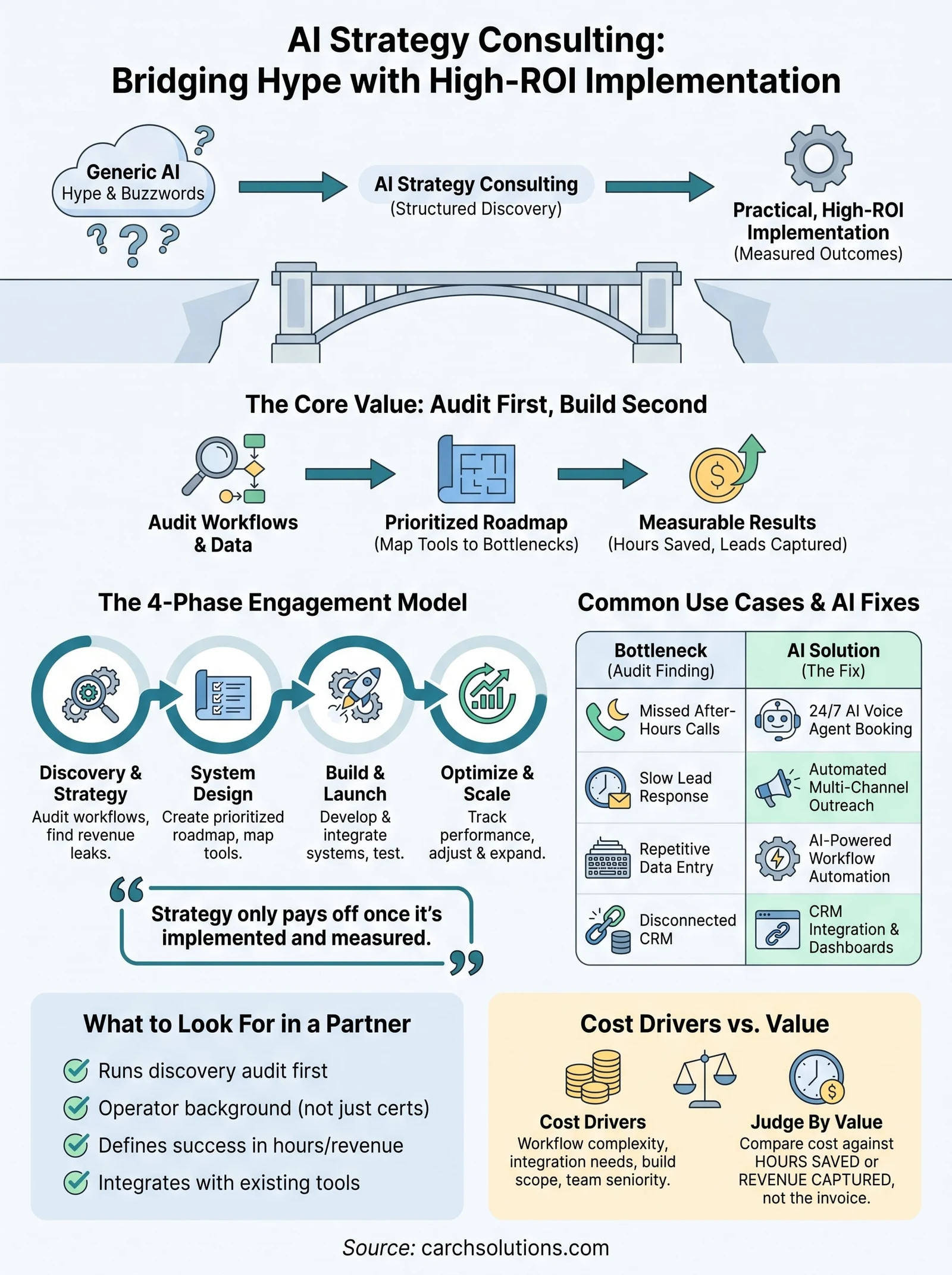
Good engagements follow a repeatable process instead of an improvised conversation. AI strategy consulting typically moves through four phases: discovery, design, build, and optimization, each with a clear deliverable so you know exactly what you’re paying for and when.
The four-phase engagement model
Here’s how a structured engagement usually unfolds:
- Discovery and strategy: The consultant audits your workflows, call data, CRM, and staff time to find where hours and revenue are leaking.
- System design: Findings turn into a prioritized roadmap that maps specific tools, like voice agents or workflow automation, to specific bottlenecks.
- Build and launch: The recommended systems get built, tested, and integrated with your existing software rather than replacing it wholesale.
- Optimize and scale: Performance gets tracked against the original targets, and the roadmap adjusts as new use cases surface.
A roadmap without a build phase is just a slide deck; strategy only pays off once it’s implemented and measured.
Each phase should end with something concrete, a document, a working system, or a report, not just a meeting summary. Firms that skip discovery and jump straight to selling a platform are usually optimizing for their own product, not your bottleneck. Look for consultants who insist on the audit step even when you’re eager to start building, since that patience is what separates a strategic partner from a vendor with a quota.
What to look for in an AI strategy consulting partner
Picking the wrong partner costs more than the engagement fee, it costs the months you spend building on a flawed roadmap. When you’re vetting ai strategy consulting services, look past the sales deck, get clear on what AI consulting services actually include, and ask who built the systems being proposed. Firms that only sell software licenses rarely have the operational background to diagnose a real bottleneck, they just match your problem to whatever they’re already selling.
Operator background matters more than certifications
Experience running operations, not just implementing tools, is what separates a consultant who can spot a broken workflow from one who’s reading a checklist. A consultant who’s managed logistics, staffing, or customer service knows what a missed call or a backlog actually costs before a single dashboard confirms it.
The best AI strategy partners have run operations themselves, not just sold software to people who do.
A short checklist before you sign
Use this list to screen any firm before committing budget, whether you found it yourself or through a comparison of the top AI consulting firms:
- Do they run a discovery audit before recommending tools?
- Will you work directly with senior staff, not a rotating account manager?
- Do they define success in hours saved or revenue captured, not vague “efficiency”?
- Can they show measurable results from past engagements?
- Do they integrate with your existing CRM instead of replacing it?
Companies like CARCH Solutions structure their AI consulting engagements around these exact questions, starting every relationship with an audit rather than a pitch.
Common AI use cases uncovered through strategy consulting
Discovery audits tend to surface the same handful of bottlenecks across industries, even though owners rarely notice them until someone maps the hours. Missed after-hours calls top the list for home services and trade businesses, followed closely by slow lead follow-up and CRM records nobody trusts. Strategy consulting exists to turn these patterns into a prioritized build list instead of a vague sense that “we should automate something,” and a quick automation readiness assessment can show you where your own leaks are before an audit even starts.
Where the hours actually go
Once the audit is done, the use cases usually sort into a few clear buckets:

| Bottleneck found in audit | Common AI fix |
|---|---|
| After-hours or overflow calls | 24/7 AI voice agent booking and qualifying leads |
| Slow lead response times | Automated multi-channel outreach and follow-up sequences |
| Repetitive data entry | AI-powered workflow automation between existing tools |
| Disconnected CRM and reporting | CRM integration with real-time dashboards |
| Website visitors who never convert | Conversion-focused web design paired with AI chatbots |
The most valuable AI use case is rarely the flashiest one, it’s the leak that’s been costing you money the longest.
Sequencing matters as much as selection
Sequencing these fixes correctly is what separates a working system from a pile of disconnected software. Consultants typically recommend tackling the highest-hour-loss bottleneck first, often call handling or lead follow-up, before layering in more complex builds like custom AI agent development or data intelligence dashboards. Skipping that order usually means paying twice: once for the tool, and again to fix the workflow it should have been built around.
AI strategy consulting costs and what drives them
Pricing for ai strategy consulting varies more than most owners expect, because the cost depends less on the label “consulting” and more on how much building follows the audit. A pure strategy engagement, an audit plus a roadmap document, tends to run far less than a full engagement that includes building voice agents, integrating a CRM, or standing up dashboards. Vague quotes usually mean the firm hasn’t scoped your actual bottlenecks yet.
Cheap strategy that never gets built costs more than expensive strategy that does.
What actually moves the price
A few factors consistently drive the range you’ll see quoted:
| Cost driver | Why it matters |
|---|---|
| Number of workflows audited | More departments and tools mean a longer discovery phase |
| Systems to integrate | Legacy CRMs and disconnected software take more engineering time |
| Build complexity | A single voice agent costs less than custom multi-agent automation |
| Ongoing optimization | Monthly monitoring and adjustments add recurring cost |
| Team involvement | Working directly with senior operators, not junior staff, often costs more but wastes less time |
Judge cost against hours saved, not the invoice
Compare any quote against the hours or revenue it’s meant to recover, not against a competitor’s sticker price, and run the numbers on how much AI automation actually saves before you sign. A firm that can point to specific outcomes, like calls captured after hours or leads converted faster, justifies its fee with numbers instead of promises. If a consultant can’t estimate the return before you sign, that’s a warning sign worth taking seriously.
Turning AI strategy into action
A roadmap only matters if someone builds it. AI strategy consulting gives you the audit, the priorities, and the numbers, but the real payoff shows up months later when calls get answered, leads get followed up, and your team stops doing work a system could handle. The businesses that come out ahead treat strategy as the first step in a build, not a standalone deliverable they file away and forget.
If you’re evaluating ai strategy consulting services right now, judge every firm on whether they’ll still be around for the build and the optimization phase, not just the audit. That’s where most of the value actually gets created. CARCH Solutions runs that entire process under one roof, from discovery through launch, with the core team involved at every stage. If you’re ready to see where your own hours and revenue are leaking, book a free 30-minute AI strategy session and get a roadmap built around your business, not a pitch deck.
About CARCH Solutions, a Miami-based AI automation agency helping small businesses automate operations and scale revenue with AI voice agents, outbound systems, and custom workflow automation.