10 Best AI Voice Agent Platforms 2026
Compare 10 top AI voice agent platforms for 2026, from developer APIs to managed solutions, and find the right fit for your business calls.
 Carlos Charria · Founder & CEO
 Every missed call is a lead talking to your competitor instead of you. If your front desk can’t pick up after 6pm, or your team spends half its day qualifying the same repetitive questions, you’ve probably already started shopping ai voice agent platforms to fix it. The problem is the market is crowded with tools that all claim to sound human, book appointments, and work in every language, and the differences only show up once you’re mid-implementation.
This list cuts through that noise. We’re comparing the best ai voice agent platform options for 2026 based on what actually matters for call handling: language coverage, integration depth with your CRM, pricing structure, and how well each one holds up on real customer calls, not scripted demos. Whether you’re evaluating a voice ai agent platform for a single use case or looking to replace an entire call center function, you’ll find a clear fit here.
We built this guide from hands-on experience deploying ai voice agents for small and mid-sized businesses in logistics, home services, and professional services. Below, you’ll get ten platforms worth considering, what each one does best, where it falls short, and how to match the right option to your call volume and budget.
1. What is an AI voice agent platform?
An AI voice agent platform is software that lets a computer answer, make, and carry on phone calls the way a trained employee would, using natural language understanding instead of a rigid phone tree. Instead of pressing 1 for sales and 2 for support, a caller just talks, and the system figures out intent, pulls the right information, and responds in a voice that sounds close to human. Under the hood, these platforms stitch together speech-to-text, a language model that decides what to say next, and text-to-speech, all running fast enough that the conversation doesn’t feel laggy.
Most platforms package that stack into a few core capabilities you’ll compare across every vendor on this list:
- Speech recognition and turn-taking: how accurately the system transcribes speech and handles interruptions or overlapping talk
- Conversation logic: whether you build flows with a visual builder, prompt a language model directly, or both
- Voice quality and latency: how natural the voice sounds and how much delay exists between the caller finishing a sentence and the agent responding
- Integrations: native connections to your CRM, scheduling tools, and telephony provider
- Language and accent coverage: how many languages the agent handles without sounding robotic
Underneath those features, the actual work an agent does breaks down into a smaller set of jobs. Call handling covers answering inbound calls around the clock, so you stop losing leads to voicemail, which is the core case for AI voice agents in a small business. Qualification means asking the right questions to determine if a caller is worth a live handoff. Scheduling ties the conversation directly into your calendar so appointments get booked without a human touching the exchange. And outbound calling lets the same agent follow up on leads, confirm appointments, or run reminder campaigns without a dialer team.
The best AI voice agent isn’t the one with the most humanlike voice, it’s the one that reliably books the appointment and hands off cleanly when it can’t.
Where platforms genuinely differ is depth versus flexibility. Some, like Retell AI or Vapi, hand you raw building blocks and expect a developer to wire them together. Others, like CARCH Solutions, deliver a managed ai voice agent service where the strategy, scripting, and integration work is done for you, so a business owner never has to touch an API. Still others sit in between, offering a no-code builder aimed at marketing or ops teams rather than engineers. Knowing which category fits your team’s technical bandwidth matters as much as the feature list, because a powerful platform that nobody on your staff can maintain won’t save you a single missed call.
2. How to choose the right AI voice agent platform
Picking the right tool starts with mapping your actual call volume, not the feature you saw in a demo video. A business fielding 50 calls a month needs something very different from one fielding 5,000, and most ai voice agent companies price and build for one end of that range, not both. Start by counting your missed calls over a real month, run the numbers on what those hours and lost leads cost you, then work backward into what volume and complexity you’re actually solving for.
Next, look at how each platform handles the handoff moments that make or break trust with callers. Does it transfer cleanly to a human when a question falls outside its script? Does it text a confirmation after booking, or just hang up and hope? These small mechanics matter more than voice quality once you’re live, because a caller who gets stuck in a loop will hang up and call your competitor instead.
A voice agent that sounds perfect in a demo but can’t hand off a confused caller will cost you more leads than it saves.
Beyond that, weigh these five factors against your shortlist before you sign anything:
- Integration depth: does it connect natively to your CRM and calendar, or require custom middleware?
- Language coverage: how many languages and accents does it actually handle well, not just claim to support?
- Setup model: will you build this yourself, or does a team manage it for you?
- Pricing structure: per-minute, per-seat, or flat monthly, and does it scale predictably with your call volume?
- Support and iteration: who fixes the script when it stops converting after month two?
Run that checklist against every vendor below, and the right fit gets a lot easier to see.
3. CARCH Solutions
CARCH Solutions takes a different approach than most names on this list: instead of handing you a dashboard and a knowledge base article, the team builds and manages your AI answering service as part of a broader automation system tailored to your business. Founded by a former Amazon Senior Program Manager, the agency applies operations discipline to voice deployment, meaning scripts get built around your actual call patterns, not a generic template pulled from a demo library.

How it works
During onboarding, CARCH maps your call flow, common objections, and booking rules, then configures a voice agent that answers in 17 languages, qualifies callers, and books directly into your calendar. Handoffs to a live team member happen automatically when a call falls outside the script, and every conversation logs into your CRM without manual entry thanks to CRM and systems integration work done during setup. The agent works alongside CARCH’s other AI workflow automation and lead generation systems, so voice data feeds the same dashboards you use to track ad spend and pipeline.
Who it’s for
This platform fits small and mid-sized business owners in home services, professional services, logistics, and retail who want a working system, not a build-it-yourself toolkit. It suits teams without in-house developers who’d rather work directly with the people configuring the agent than route requests through a support ticket queue.
A managed voice agent only earns its keep if someone is actually watching the numbers and adjusting the script.
Pricing
CARCH prices engagements around a structured four-phase process (Discovery & Strategy, System Design, Build & Launch, Optimize & Scale), so cost depends on call volume and how much of the broader automation stack you need. Book a call through the CARCH Solutions site to get a quote scoped to your actual missed-call numbers rather than a generic per-minute rate.
4. Retell AI
Retell AI is a developer-first voice ai agent platform built for engineering teams that want raw building blocks instead of a finished product. It gives you the speech-to-text, language model orchestration, and text-to-speech pipeline as an API, along with a dashboard for testing call flows before you push them live. Unlike CARCH’s managed model, Retell expects someone on your team to write the logic, connect the webhooks, and maintain the integration over time.
How it works
You define conversation logic through prompts and function calls, then connect Retell to your telephony provider (Twilio is the common pairing) to handle inbound and outbound calls. Retell handles the latency-sensitive parts, like interrupting the agent mid-sentence when a caller talks over it, and exposes webhooks so a call outcome can trigger actions in your CRM or scheduling tool. Debugging happens through call recordings and transcripts inside the dashboard, which helps when a script isn’t converting the way you expected.
Raw building blocks give you flexibility, but only if someone on staff has the time to keep wiring them together.
Who it’s for
Retell suits software teams and technical founders building a custom voice product on top of the API, not a business owner who wants a phone answered by next week. It’s a strong pick if you already have engineers building internal tools and want voice as another integration point, rather than a packaged ai voice agent service.
Pricing
Retell charges per minute of call time, with published rates in the range of $0.07 to $0.08 per minute plus underlying LLM and telephony costs, which stack up fast at higher volume. There’s no flat managed-service tier, so budgeting requires forecasting call minutes accurately or risking a surprise bill.
5. PolyAI
PolyAI targets large-scale enterprise call centers, positioning itself as an ai voice agent platform built for brands that field millions of calls a year rather than a few hundred. The company builds heavily around voice quality and conversational realism, marketing its agents as able to handle accents, interruptions, and multi-turn conversations without breaking character. That focus makes sense given its client roster, which leans toward large retail, hospitality, and financial services brands with dedicated contact center budgets.
How it works
PolyAI builds custom voice assistants for each client through a consultative process, meaning their team designs conversation flows, tunes the voice model, and integrates with existing contact center infrastructure like Genesys or NICE. The platform handles high call volume with enterprise-grade uptime guarantees and supports multiple languages, though the depth of that coverage depends on the specific deployment. Unlike self-serve tools, you don’t log into a dashboard and build flows yourself; PolyAI’s team does the configuration work, similar in spirit to a managed ai voice agent service but scoped for enterprise contracts rather than small business budgets.
Enterprise-grade voice quality means little if the platform is priced and built for a call volume you’ll never reach.
Who it’s for
PolyAI fits large enterprises with existing contact center infrastructure and the budget for a custom-built deployment, typically brands already running six or seven-figure call center operations. It’s a poor match for small or mid-sized businesses looking for a quick setup, since the sales and implementation process is built around enterprise procurement timelines, not a business owner who needs calls answered next week.
Pricing
PolyAI doesn’t publish pricing, and deals are negotiated individually based on call volume, languages, and integration scope. Expect a sales process involving multiple calls and a custom proposal rather than a self-serve signup, which rules it out for businesses wanting transparent, predictable costs upfront.
6. Bland AI
Bland AI markets itself as a developer-focused voice ai agent platform built for teams that want to deploy at scale without touching a call center vendor’s enterprise sales cycle. The company leans hard on infrastructure claims, promising low-latency calls and the ability to spin up thousands of concurrent conversations, which appeals to businesses running large outbound campaigns rather than a single inbound line. Its pitch sits closer to Retell than to a managed service, giving technical teams a programmable layer instead of a finished product.

How it works
Bland gives you an API and a pathway builder for designing conversation logic as a flowchart, so you can branch a call based on caller responses without writing raw prompts for every turn. Teams connect it to their own telephony and CRM through webhooks, and Bland handles the voice synthesis and turn-taking underneath. The platform also supports batch outbound calling, letting you queue thousands of calls for reminders or lead follow-up in one push.
A platform built for volume only helps if your team has the bandwidth to manage that volume once it’s live.
Who it’s for
This fits engineering teams running high-volume outbound campaigns, like debt collection reminders, appointment confirmations, or lead qualification at scale. It’s a weaker fit for a small business owner who wants a single agent answering inbound calls with minimal setup, since Bland assumes someone technical is building and monitoring the pathways.
Pricing
Bland charges per minute, with published rates starting around $0.09 per minute for standard voice calls, before added telephony and enterprise features. Volume discounts exist for higher usage tiers, but there’s no flat managed package, so cost tracks directly with call minutes and campaign size.
7. Synthflow AI
Synthflow AI positions itself as a no-code ai voice agent platform built for agencies and small business owners who want to build a working agent without writing a line of code. The pitch leans on speed: drag-and-drop flow building, prebuilt templates for common use cases like appointment booking and lead qualification, and a setup process meant to take hours instead of weeks. That makes it a popular pick among the growing wave of ai voice agent companies reselling white-labeled voice agents to their own clients.
How it works
Inside Synthflow, you build conversation flows visually, connecting nodes for greetings, qualifying questions, and handoffs without touching an API directly. The platform includes native integrations for calendars and popular CRMs, plus a testing sandbox where you can call your own agent before pushing it live. Synthflow also supports white-labeling, letting agencies rebrand the platform and resell it under their own name to clients who never see the underlying tool.
No-code flexibility is only worth it if the templates actually match how your customers talk.
Who it’s for
This fits agencies and solo operators who want to build and manage multiple client agents without hiring developers, plus small business owners comfortable building their own flows. It’s a weaker match for anyone who wants a partner handling strategy and script iteration, since Synthflow hands you the builder and expects you to maintain it.
Pricing
Synthflow runs on tiered monthly subscriptions starting in the low hundreds of dollars, with plans scaling by included call minutes and number of concurrent agents. Higher tiers unlock white-labeling and priority support, but per-minute overage charges apply once you exceed your plan’s included usage, which matters if your call volume spikes seasonally.
8. Vapi
Vapi is a developer-centric voice ai agent platform built for teams that want full control over the voice stack without assembling speech-to-text, language model, and text-to-speech providers themselves. It functions as an orchestration layer, letting you plug in your preferred models (OpenAI, Anthropic, Deepgram, ElevenLabs, and others) rather than locking you into one vendor’s voice. That flexibility has made it a favorite among startups building voice products, not just businesses that need calls answered.
How it works
Developers configure agents through Vapi’s API or dashboard, defining prompts, tools, and function calls that let the agent look up data or trigger actions mid-call. The platform manages the real-time audio pipeline, including interruption handling and latency optimization, so a call doesn’t feel like it’s talking to a slow bot. Webhooks push call outcomes into your CRM or database, and a built-in testing suite lets you simulate calls before deploying to real phone numbers.
Model flexibility is only an advantage if someone on your team actually knows which model to pick.
Who it’s for
Vapi suits technical teams and startups building voice features into their own product, or agencies with developer resources who want to assemble a custom stack rather than accept one vendor’s defaults. It’s a poor fit for a business owner who wants a phone answered next week, since getting real value out of Vapi means writing code and testing configurations across multiple providers.
Pricing
Vapi charges based on usage, combining a per-minute platform fee (commonly cited around $0.05 per minute) with pass-through costs for whichever transcription, language model, and voice providers you choose. There’s no flat managed package, so your total bill depends heavily on which underlying models you select and how much call volume you run.
9. Cognigy by NICE
Cognigy by NICE is an enterprise conversational AI platform built for large contact centers that need voice agents woven into an existing customer service stack rather than running as a standalone tool. NICE acquired Cognigy to fold its conversational AI engine into its broader contact center software, so the platform now ships with deep ties to case management, workforce tools, and analytics that most standalone ai voice agent platforms don’t offer. That positioning puts it closer to PolyAI than to a self-serve builder, aimed at organizations replacing an entire IVR system, not adding a single line.

How it works
Teams build voice and chat agents through Cognigy’s low-code flow designer, combining natural language understanding with prebuilt connectors to CRM, ticketing, and telephony systems already running in the contact center. The platform routes calls between AI and human agents based on confidence scores, so a caller gets escalated the moment the bot’s understanding drops below a set threshold. Because it’s built for omnichannel deployment, the same conversation logic can power a phone call, a chat widget, or a messaging app without rebuilding flows from scratch.
A voice agent bolted onto legacy contact center software only works if that software already fits how your team operates.
Who it’s for
Cognigy suits large enterprises and contact centers already running NICE’s customer service suite, or teams large enough to justify a dedicated implementation team. It’s a mismatch for a small business owner comparing the best ai voice agent platform for a handful of phone lines, since the tooling and pricing assume enterprise-scale call volume.
Pricing
Cognigy doesn’t publish pricing publicly, and deals get quoted through a sales process based on channel volume, seat count, and integration scope. Expect a multi-call enterprise sales cycle rather than a self-serve signup or transparent monthly rate.
10. CloudTalk
CloudTalk started as a cloud-based business phone system before layering AI voice agent features on top, which makes it a different animal than the developer-first tools earlier on this list. Teams already running CloudTalk for call center operations get access to an AI voice agent platform without switching phone providers, since the voice bot sits inside the same dashboard as call routing, recording, and analytics. That bundling appeals to businesses that want phone infrastructure and automation from one vendor instead of stitching a voice AI tool onto a separate PBX.
How it works
Inside CloudTalk, you configure an AI agent to handle inbound calls, qualify leads, or route callers based on intent, then hand off to a live agent through the same interface your team already uses for regular calls. The platform includes native CRM integrations with tools like HubSpot, Pipedrive, and Salesforce, so call outcomes sync automatically without a middleware layer. Because it’s built on established call center software, features like call recording, real-time analytics, and workforce reporting come standard alongside the voice agent itself.
Bundling AI voice features into existing phone software only pays off if you were already planning to switch providers.
Who it’s for
CloudTalk fits businesses replacing an outdated phone system who want AI call handling included rather than bolted on separately, particularly sales and support teams already managing high call volume. It’s a weaker fit if you just need a standalone voice agent and don’t want to migrate your entire phone infrastructure to adopt it.
Pricing
CloudTalk prices its core phone plans per user per month, starting around $25, with AI voice agent features available on higher tiers or as an add-on. Exact costs depend on seat count and which AI capabilities you enable, so get a quote scoped to your team size before committing.
11. Lindy AI
Lindy AI markets itself as an AI employee builder rather than a narrow call-answering tool, with voice agents as one piece of a broader automation suite that also handles email, scheduling, and internal workflows. Founders who want a single assistant that answers calls and then follows up by email or Slack tend to land here, since Lindy treats voice as another channel a single agent can operate in, not a separate product. That positioning sets it apart from most of the ai voice agent platforms on this list, which stay focused on the phone line alone.
How it works
Inside Lindy, you build an agent through a visual, no-code workspace, assigning it a phone number, a set of instructions, and access to tools like your calendar, CRM, or inbox. The agent answers or places calls, then can chain that conversation into a follow-up task, like drafting a summary email or updating a deal stage, without you touching a second app. Lindy also lets you connect multiple agents together, so a voice agent can hand a qualified lead to a separate research or outreach agent automatically.
A voice agent that can only answer calls leaves half the follow-up work sitting on your desk anyway.
Who it’s for
Lindy suits solo founders and small teams who want one tool covering voice plus the administrative work that follows a call, rather than stitching together separate point solutions. It’s a weaker fit for businesses needing deep telephony features like advanced call routing, since Lindy’s strength is breadth across tasks, not depth on the phone system itself.
Pricing
Lindy runs on tiered monthly subscriptions, with a free plan for light use and paid tiers starting in the range of $50 to $100 per month scaling by task volume and number of active agents. Voice minutes typically draw from the same usage pool as other agent tasks, so heavy callers will outgrow lower tiers quickly.
12. Voiceflow
Voiceflow started as a chatbot and conversational design tool before expanding into full voice ai agent platform territory, and that design heritage still shows in how the product feels. Teams that already used Voiceflow to map chat flows for a website widget often extend the same canvas to build a phone agent, which makes it a natural next step rather than a new tool to learn from scratch. Unlike CARCH’s managed approach, Voiceflow hands you the canvas and expects your team to design, test, and maintain the conversation yourself.
How it works
Inside Voiceflow, you build conversation logic on a visual canvas, dragging blocks for prompts, conditions, and API calls rather than writing raw code for every branch. The platform supports both voice and chat from the same project, so a flow built for your website bot can be adapted into a phone agent without starting over. Voiceflow connects to external services through API blocks, meaning your CRM or scheduling tool needs a defined integration before the agent can act on it mid-call.
A visual canvas speeds up building a flow, but someone still has to test every branch a real caller might take.
Who it’s for
Voiceflow fits product and design teams who want fine-grained control over conversation structure and already have some flow-building experience from chatbot projects. It’s a weaker fit for a business owner who wants a phone answered without learning a new tool, since getting real value out of Voiceflow means investing time in the builder itself.
Pricing
Voiceflow runs on tiered monthly plans, with a limited free tier for testing and paid plans scaling by seats and monthly conversations. Voice-specific usage and higher conversation volume push you into custom enterprise pricing, so budget for a jump once you move past prototyping.
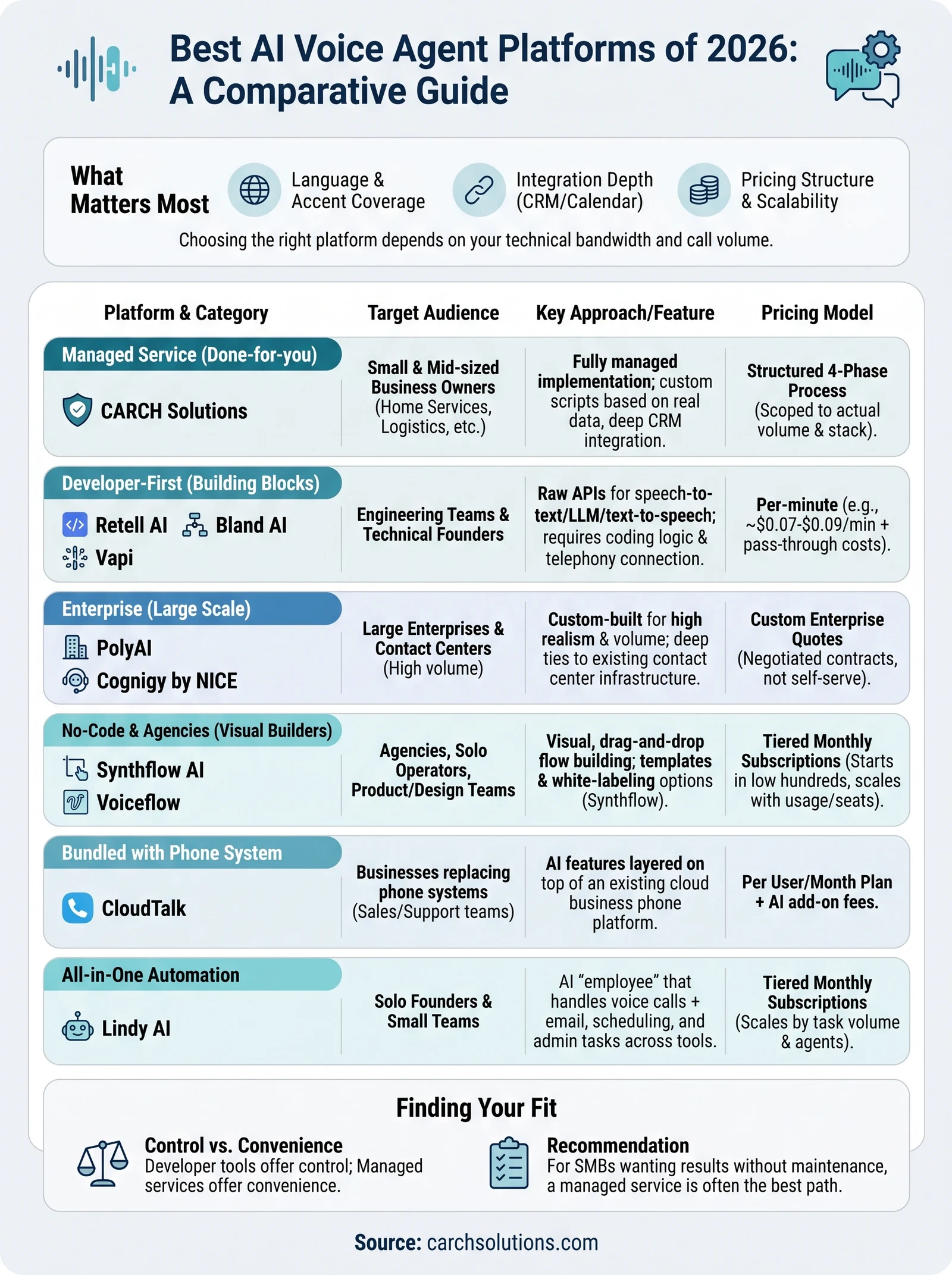
Finding the right voice agent for your business
Every platform on this list can technically answer a phone call, but that’s the easy part. The real differences show up in who builds the script, who fixes it when conversion drops, and whether the system talks to your CRM without a developer stitching things together. Developer-first tools like Retell, Bland, and Vapi reward teams with engineering bandwidth. No-code builders like Synthflow and Voiceflow suit teams willing to own the flow themselves. Enterprise platforms like PolyAI and Cognigy make sense once you’re already running a large contact center, not before.
If you’re a small or mid-sized business owner who wants calls answered, leads qualified, and appointments booked without becoming the person who maintains an API integration, a managed ai voice agent service solves the actual problem instead of adding another tool to babysit. Book a free 30-minute strategy session and get a voice agent scoped to your real call volume, not a generic demo.
About CARCH Solutions, a Miami-based AI automation agency helping small businesses automate operations and scale revenue with AI voice agents, outbound systems, and custom workflow automation.