Generative AI Consulting: What It Is
See how generative AI consulting works: CARCH's 4-phase process, pricing models, vetting questions, and real use cases to automate smarter.
 Carlos Charria · Founder & CEO
 You’ve heard the pitch a hundred times: AI will save your business hours and money. But when you try to find out what that actually looks like for your company, most explanations either stay too abstract or jump straight into technical jargon. Generative ai consulting exists to close that gap between the hype and a working system you can actually run.
At its core, this type of consulting means an outside team assesses where your business loses time on manual work, then designs, builds, and manages AI tools that fix it, whether that’s a chatbot trained on your data, a voice agent that answers calls, or automated workflows that replace repetitive tasks. A good gen ai consulting engagement gives you a clear roadmap, not just a vendor selling software.
This article breaks down what generative AI consulting actually involves, how the process typically works from discovery to launch, and what separates strong generative ai consulting companies from ones that oversell and underdeliver. We’ll also cover what to look for if you’re evaluating a generative ai consulting company for your own operations.
Why generative AI consulting matters for your business
Every hour your staff spends on data entry, appointment scheduling, or chasing unanswered leads is an hour they’re not spending on the work that actually grows revenue. Most small and mid-sized businesses don’t have a technical team on staff to figure out which tasks are worth automating or how to build the system safely. That’s the gap generative ai consulting services fill: someone with hands-on experience looks at your actual operations, not a generic template, and tells you where AI will move the needle and where it won’t.
Missing calls after hours or responding to a lead a day late doesn’t just feel bad, it costs closed deals. Studies on lead response time consistently show that contacting a prospect within minutes dramatically increases the odds of conversion, and that window keeps shrinking as customers expect instant answers. A gen ai consulting partner can point you toward tools like 24/7 voice agents or chat assistants that catch those leads the moment they come in, instead of leaving them for a callback the next morning.
A missed call at 9pm is a lead your competitor answers instead.
DIY tools rarely solve the whole problem
Plenty of business owners try to shortcut this by grabbing an off-the-shelf chatbot or a subscription automation tool. These can help in isolated cases, but they usually fail to connect to your CRM, don’t reflect your actual sales process, and break down the moment a customer asks something outside the script. Generative ai consulting and implementation services exist precisely because stitching together tools without a strategy behind them creates more mess than it solves, disconnected systems, duplicate data, and staff who still have to double-check everything the

How generative AI consulting works, step by step
A structured generative ai consulting engagement doesn’t start with a demo of shiny software. It starts with a conversation about your business, your bottlenecks, and your numbers, which is exactly how AI strategy consulting works from audit to launch. The best firms follow a repeatable process instead of improvising a new plan for every client, because repeatable processes are what let you compare cost against outcome later. At CARCH Solutions, that process runs through four distinct phases, and most credible generative ai consulting services follow a similar shape even if they use different names for it.
Before any code gets written or any AI agent gets configured, a consultant needs to understand where your time and money actually go. This discovery phase usually involves interviews with your team, a review of your CRM and call logs, and an audit of which tasks are truly repetitive versus which ones need human judgment. Skipping this step is the single biggest reason automation projects fail: you end up automating the wrong thing well instead of the right thing at all.
The right automation strategy starts with an honest audit of where your time actually goes, not with a tool demo.
The four phases in practice
Once the audit is done, the work moves into design, build, and ongoing management. Here’s what that typically looks like:
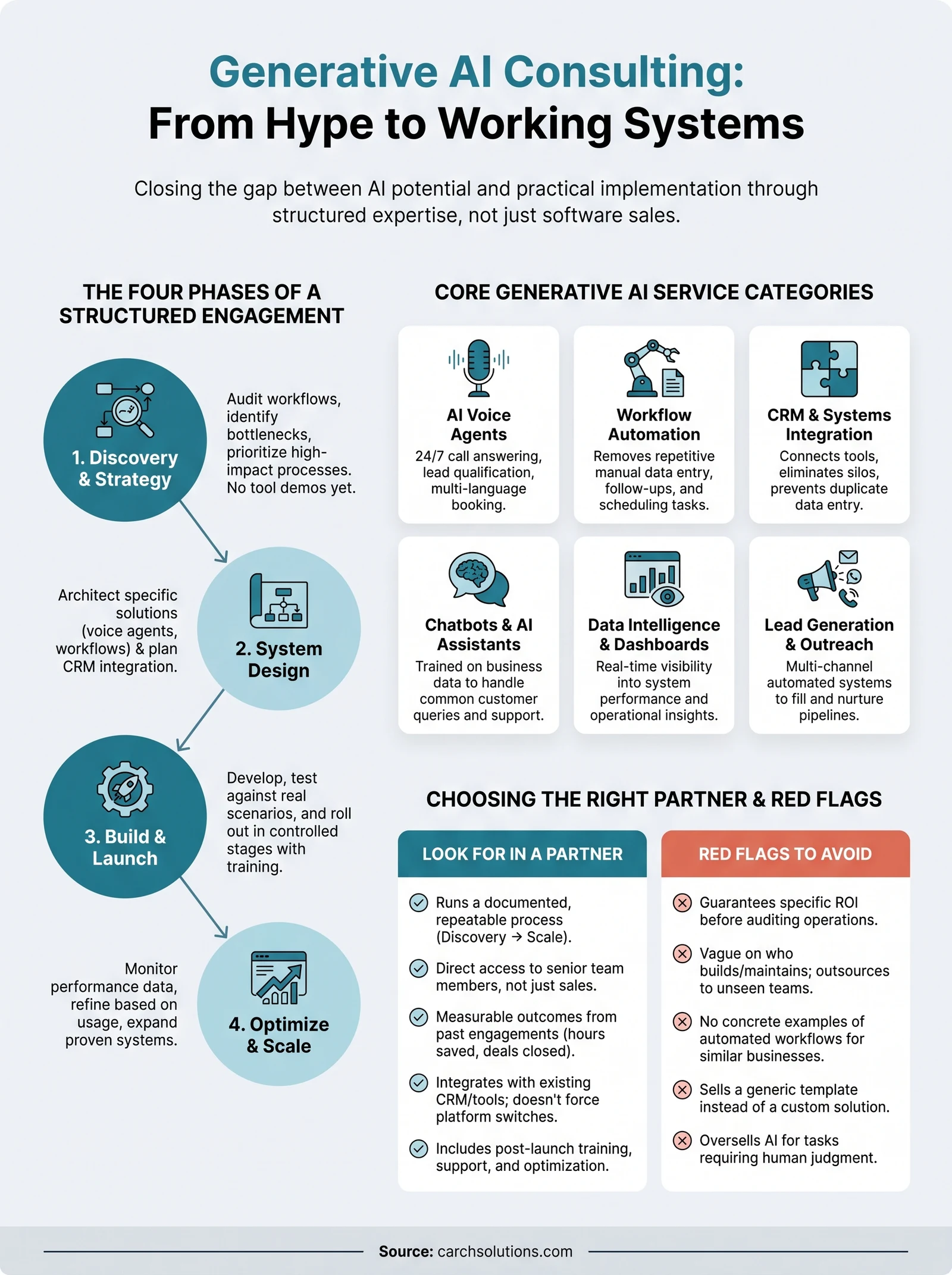
- Discovery & Strategy: Map current workflows, identify time sinks, and prioritize which processes offer the fastest return.
- System Design: Architect the specific solution, whether that’s a voice agent, chatbot, or backend workflow, and decide how it connects to your existing CRM and tools.
- Build & Launch: Develop and test the system against real scenarios before it touches live customers, then roll it out in stages.
- Optimize & Scale: Monitor performance data, refine the system based on real usage, and expand it to other parts of the business once it’s proven.
CARCH Solutions runs every engagement through this same four-phase process, documented in detail in how the work is actually scoped, and it’s worth asking any firm you’re evaluating whether they can describe their own version of it in similarly concrete terms.
Getting this sequence right matters because each phase depends on the one before it. Handing you a chatbot without mapping your workflows first is like installing a new phone system without checking whether your team even needs one. Involving your staff early, especially the people who handle the calls or data entry being automated, also cuts down on resistance later, since they can flag edge cases a consultant might miss on a first pass. Jumping straight to a build phase without that groundwork is exactly how businesses end up with tools nobody trusts or uses.
What generative AI consulting services typically include
Ask five firms what’s included in AI consulting services and you’ll get five different answers, but the strong ones tend to cover the same ground: voice and chat automation, workflow design, data integration, and ongoing optimization. Generative ai consulting services rarely stop at strategy alone. A consultant who only hands you a slide deck and walks away hasn’t actually solved your bottleneck, they’ve just described it back to you with nicer language.
A consulting engagement that ends at a strategy document hasn’t automated anything yet.
The core service categories
Most credible engagements draw from a consistent menu of services, even if the mix changes based on your industry and budget. Here’s what typically shows up in a scope of work:
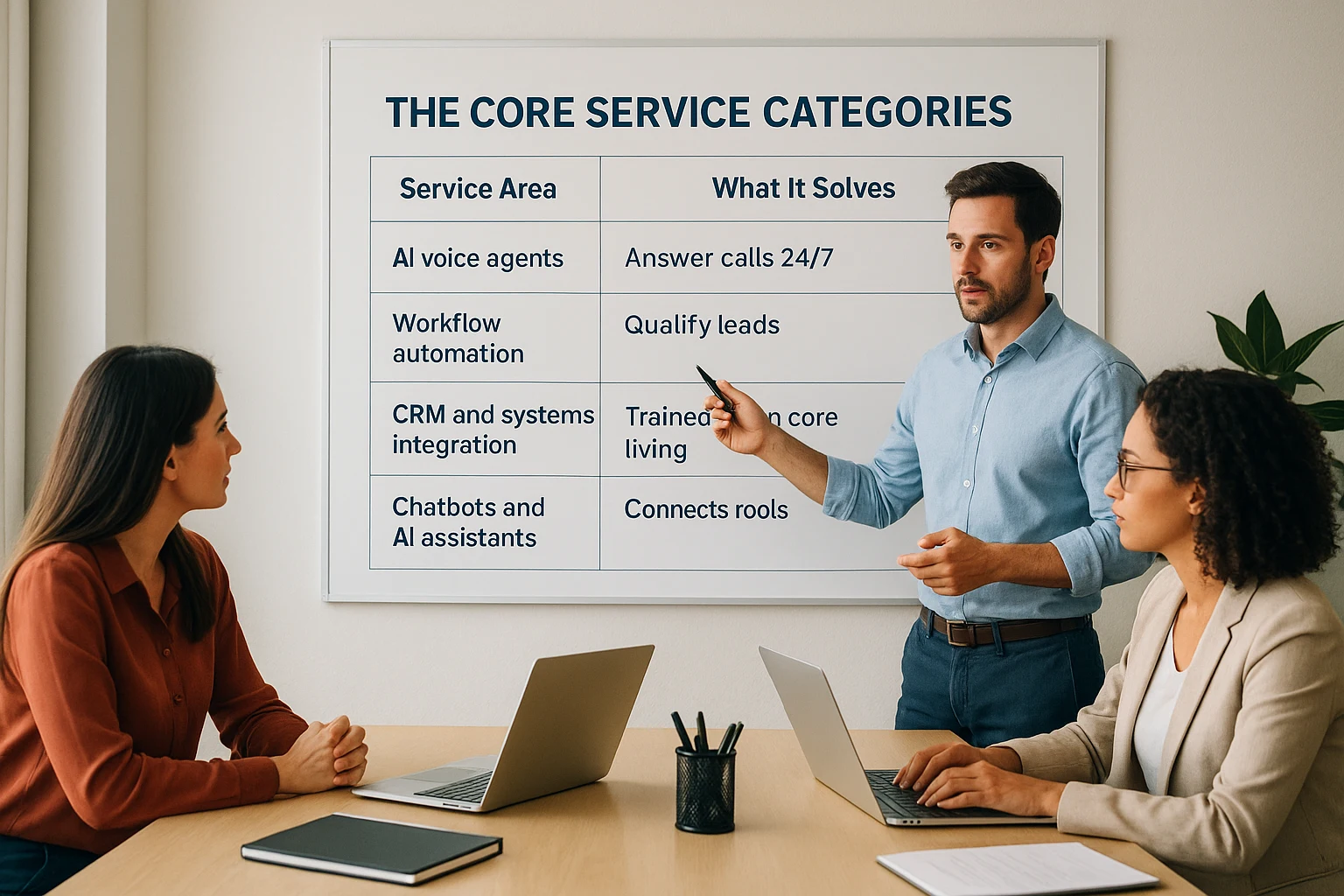
| Service Area | What It Solves |
|---|---|
| AI voice agents | Answer calls 24/7, qualify leads, book appointments across multiple languages |
| Workflow automation | Removes repetitive manual tasks like data entry and follow-up scheduling |
| CRM and systems integration | Connects tools so data stops living in silos and staff stop double-entering it |
| Chatbots and AI assistants | Trained on your business data to handle common customer questions |
| Data intelligence and dashboards | Gives you real-time visibility into what’s actually working |
| Lead generation and outreach | Multi-channel systems that fill the pipeline instead of waiting for inbound |
Bundling these together is what separates a generative ai consulting company built for long-term results from one selling a single point solution. A voice agent that answers calls but doesn’t sync with your CRM just creates a new manual task: someone still has to copy that lead into your system by hand.
Where implementation and training fit in
Good generative ai consulting and implementation services don’t hand you a finished tool and disappear. They pair the build with AI consulting and corporate AI training so your team knows how to use it, adjust it, and escalate the cases it can’t handle on its own. This matters more than most business owners expect going in, since an AI system left untouched after launch tends to drift out of sync with how your business actually operates six months later.
Drops in performance often trace back to skipped training, not a bad tool, which is why AI training workshops for business teams rarely stick without follow-up. Firms that build in check-ins, usage reviews, and retraining sessions as part of the base engagement, rather than charging extra for every adjustment, tend to produce systems that actually stay in use. If a proposal doesn’t mention what happens after launch, that’s worth asking about directly before you sign anything.
How to choose a generative AI consulting company
With dozens of firms claiming AI expertise, picking the right one comes down to asking harder questions than “can you build me a chatbot?” Generative ai consulting companies vary wildly in how they operate, as any side-by-side look at the leading AI consulting firms shows: some are solo freelancers reselling off-the-shelf software, others are full agencies with engineering, strategy, and support built in. The best way to tell them apart is to look at how they talk about your business specifically, not how polished their sales deck looks. If a firm can’t point to concrete examples of workflows they’ve automated for businesses like yours, treat that as a warning sign rather than an oversight.
Ask what they’ve automated for a business like yours, not what AI can theoretically do.
Questions to ask before you sign anything
Before committing budget to any generative ai consulting company, whether it’s a national agency or an AI consultant near you, run through a short list of questions that separate operators from resellers:
- Do they run a documented process (discovery, design, build, optimization), or are they improvising per client?
- Will you work directly with senior team members, or get handed off to junior staff after the sales call?
- Can they show measurable outcomes from past engagements: hours saved, response times cut, deals closed?
- Do they integrate with your existing CRM and tools, or expect you to switch platforms?
- What happens after launch: is training and optimization included, or billed separately?
- Do they have experience in your specific industry, whether that’s local services, logistics, or ecommerce?
Getting straight answers to these questions upfront saves you from discovering the gaps three months into a contract.
Watch for red flags in the sales process
Overpromising is the clearest signal something’s off. A firm that guarantees a specific ROI before ever auditing your operations is selling a pitch, not a plan. Similarly, vague answers about who actually builds and maintains the system, versus who just sells it, usually mean your project gets outsourced to a subcontractor you never meet. Legitimate gen ai consulting firms are upfront about limitations: they’ll tell you when a task isn’t a good fit for automation instead of forcing AI into every corner of your business just to close the deal.
Operator experience matters more than most buyers realize. A consultant who has actually run operations, managed logistics, or handled customer service at scale understands the tradeoffs involved in automating a workflow, not just the technical steps to build it. CARCH Solutions was founded by an ex-Amazon operations leader with logistics experience for exactly this reason: building AI systems that hold up under real operational pressure takes more than software skills.
What generative AI consulting costs
Pricing for generative ai consulting services varies more than most industries because the work itself varies so much, which also makes the cost of a partner versus an in-house hire worth comparing. A single voice agent build looks nothing like a full CRM overhaul paired with multi-channel outreach automation. Most firms price based on scope, meaning the size of the workflow being automated, how many systems it needs to connect to, and how much custom training the AI requires, rather than a flat rate for “AI consulting” as a category. Anyone who quotes you a number before auditing your operations is guessing, not pricing.
A real quote comes after an audit, not before one.
Typical pricing models
Firms generally structure fees one of three ways, and each fits a different stage of engagement. Project-based pricing covers a defined build, like launching one voice agent or automating one workflow, with a clear start and end date. Retainer pricing covers ongoing management, optimization, and support once a system is live, which matters because AI tools need tuning as your business changes. Hourly or consulting-only pricing shows up less often among full-service firms but still exists for businesses that just want a strategy audit without a build attached.
| Pricing Model | Best For | What’s Included |
|---|---|---|
| Project-based | A single defined build (one voice agent, one workflow) | Discovery, design, build, launch |
| Retainer | Ongoing systems needing tuning and support | Monitoring, optimization, retraining |
| Consulting-only | Businesses wanting a roadmap before committing to a build | Audit, strategy document, recommendations |
What actually drives the number up or down
Complexity drives cost more than anything else, and it shapes how much automation saves per workflow too. A chatbot trained on a narrow set of FAQs costs far less than a voice agent handling appointment booking across 17 languages with CRM sync and escalation rules. Integration work adds cost too: connecting to a modern CRM with open APIs is straightforward, while untangling a decade of spreadsheets and disconnected tools takes more hours before any AI even enters the picture. Businesses that come in with clean data and clear processes almost always pay less than ones that need the groundwork done first.
Estimating this yourself before you ever talk to a firm is worth doing. CARCH Solutions offers a free calculator that estimates what manual work is actually costing your business in hours and dollars, which gives you a baseline for judging whether a proposed price makes sense against the problem it’s solving.
Common generative AI use cases worth exploring
Some businesses hesitate to invest in generative ai consulting because they can’t picture what it looks like inside their own operation. Concrete examples help more than abstract promises. A home services company that used to lose after-hours calls to voicemail can deploy an AI voice agent that books the appointment on the spot. A logistics operation buried in dispatch paperwork can automate status updates and customer notifications instead of having a coordinator type them out one by one. These aren’t hypothetical use cases, they’re the exact kinds of problems generative ai consulting services are built to solve.
The best use case isn’t the flashiest one, it’s the task your team already hates doing.
Use cases by industry
Looking at how different industries apply the same underlying tools makes the possibilities easier to picture. The table below breaks down common applications by sector:

| Industry | Common Use Case |
|---|---|
| Professional services | AI chatbot qualifying inquiries and scheduling consultations |
| Home and trade services | Voice agent answering after-hours calls and booking jobs |
| Logistics and distribution | Automated status updates and workflow triggers across shipments |
| Retail and ecommerce | AI assistant handling order status, returns, and product questions |
| Any service business | CRM integration eliminating duplicate data entry between tools |
Notice that none of these examples require replacing your entire team with software. They target the specific tasks that eat hours without requiring judgment calls, which is exactly where AI performs best and where a gen ai consulting partner should be steering your first project.
Where the highest returns tend to show up
Outbound lead generation is another area worth exploring early, since it directly affects revenue rather than just cutting cost. AI lead generation and outreach systems that combine email, SMS, and voice can keep a pipeline moving even when your sales team is stretched thin, following up with prospects automatically instead of letting leads go cold after one missed call. Retention often gets less attention than acquisition, but it deserves equal consideration. Automated email and SMS nurture sequences keep past customers engaged without anyone on staff manually drafting messages every week, which matters most for businesses with long sales cycles or repeat purchase patterns.
Questioning which use case to start with is normal, and it’s exactly what a discovery phase is for. Rather than trying to automate everything at once, most generative ai consulting companies worth hiring will point you toward the single highest-friction task in your business first, prove the model works there, then expand once you’ve seen the numbers for yourself.
Putting generative AI consulting into practice
Generative AI consulting isn’t about buying software, it’s about pairing an honest audit of your operations with a team that can actually build and manage what comes out of it. The businesses that get real value skip the DIY tool grab, ask hard questions before signing anything, and start with the single task costing them the most time rather than trying to automate everything at once. Pricing follows scope, not hype, and the right partner will tell you what won’t work before they ever pitch what will.
You don’t need to figure this out alone or guess at what a fair quote looks like. If you’re ready to see where automation would actually move the needle in your business, talk to CARCH Solutions in a free strategy session and start with a real audit instead of another sales demo.
About CARCH Solutions, a Miami-based AI automation agency helping small businesses automate operations and scale revenue with AI voice agents, outbound systems, and custom workflow automation.