AI Consulting for Small Businesses
See real 2026 pricing, ROI timelines, and vetting questions for AI consulting for small businesses, plus the 4-phase process that avoids wasted spend.
 Carlos Charria · Founder & CEO
 You know AI could help your business, but you don’t know where to start or what it actually costs to find out. Every week brings another headline about AI transforming small businesses, yet most owners are still doing manual follow-up, chasing leads by hand, and missing calls after hours. AI consulting for small businesses exists to close that gap: it’s AI adoption strategy and team training that assesses your operations, identifies where automation and AI agents fit, and builds a roadmap you can actually execute, without hiring a technical team.
This article breaks down exactly what’s included in an AI consulting engagement and what you should expect to pay, whether you’re comparing a one-time strategy session or ongoing implementation support. Pricing varies widely depending on scope, and knowing the difference matters before you sign anything.
We’ll cover what a consulting engagement typically includes, how pricing models usually work, and the questions worth asking any provider before you commit. We’ll also share how CARCH Solutions approaches this work, from our four-phase process to the operator-level expertise we bring, having built and scaled real operations before automating them.
Why AI consulting matters for small businesses
Owners rarely lack ambition, they lack time. Every hour spent manually qualifying leads, updating spreadsheets, or calling back missed appointments is an hour not spent on strategy, sales, or customer relationships. AI consulting for small businesses matters because it turns that lost time into a measurable asset, showing you exactly where automation replaces repetitive work and where it doesn’t. Without a structured assessment, most businesses either avoid AI entirely or bolt on tools that don’t talk to each other, creating more mess than the problem they were meant to solve.
The hidden cost of manual work
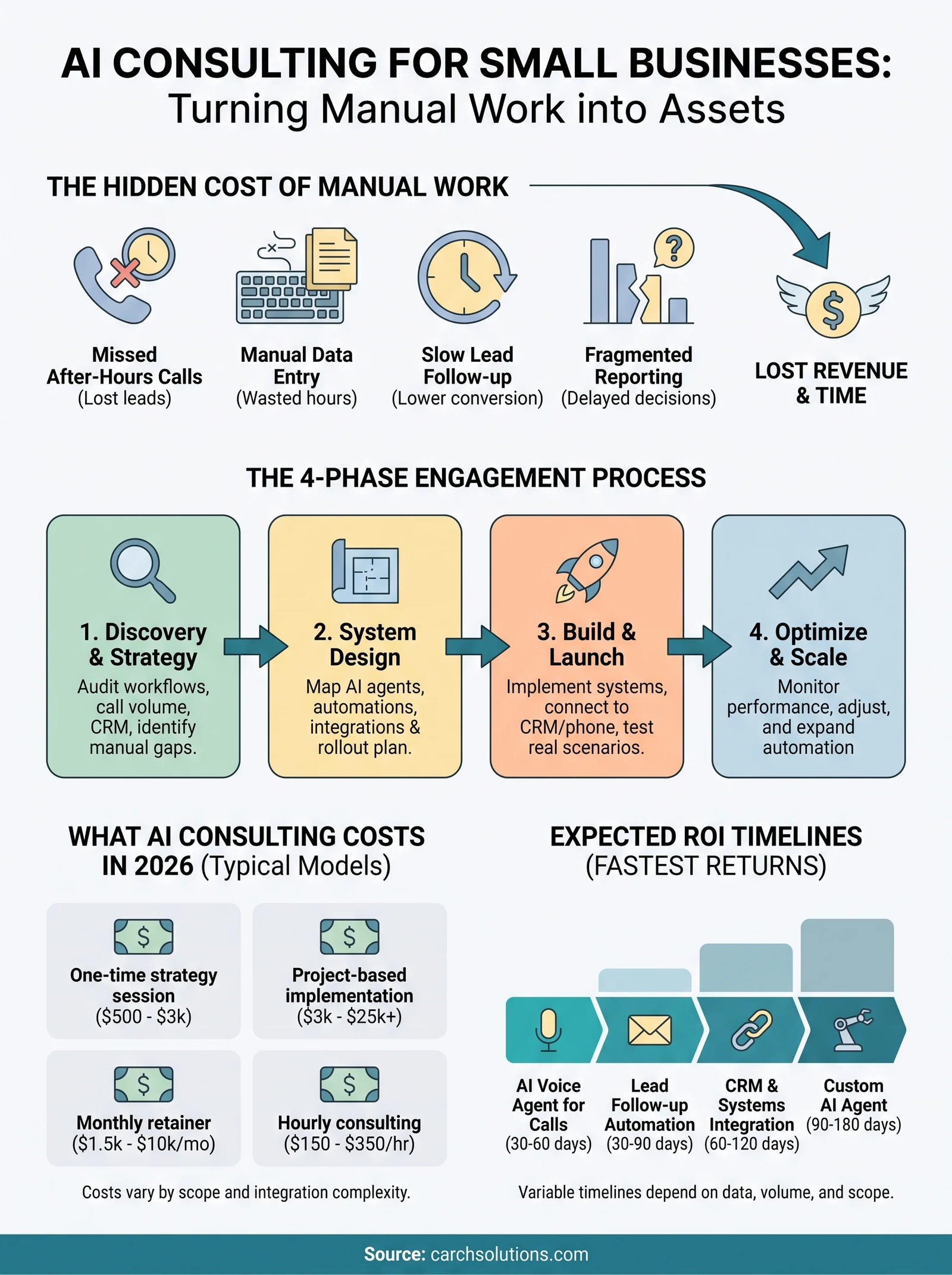
Numbers make the case better than opinions do. Consider what a typical service business loses to manual processes every month, based on patterns we see across professional services, home services, and logistics clients:

- Missed after-hours calls: many small businesses miss a meaningful share of inbound calls outside business hours, and each one is a lead that likely calls a competitor next.
- Manual data entry: staff routinely spend several hours a week re-typing information across a CRM, spreadsheets, and invoicing tools that should sync automatically.
- Slow lead follow-up: response times measured in hours instead of minutes quietly cut conversion rates, even when the lead was genuinely interested.
- Fragmented reporting: owners spend evenings reconciling numbers from three different dashboards instead of using that time to make decisions.
Stacked together, these small leaks add up to real revenue, not just wasted hours, and it takes about two minutes to put a dollar figure on those leaks.
Why DIY AI adoption usually stalls
Most owners try a chatbot or a single automation tool before ever hiring a consultant, and that’s a reasonable starting point. Problems begin when that tool works in isolation, disconnected from the CRM, phone system, or website that actually drives revenue. Good AI consulting takes a systems view instead, mapping how leads move from first contact to closed deal, then identifying which AI agents and workflows remove friction at each specific step rather than adding another disconnected app to the pile.
AI without a system built around it is just another app nobody keeps using.
That systems thinking, more than any specific tool, is what separates businesses that actually see ROI from AI from those that tried it once and gave up.
How AI consulting works, from assessment to implementation
Good AI consulting for small businesses follows a repeatable sequence, not a one-off pitch meeting. A provider worth hiring starts by mapping your current operations before recommending a single tool, because the right automation depends entirely on where your leads, calls, and data actually flow today. Skip that step and you end up buying software that solves a problem you don’t have.
The four-phase engagement process
At CARCH Solutions, we run every engagement through the same four phases, and most credible consultants use some version of this structure for how AI strategy consulting works, phase by phase:
- Discovery & Strategy: audit your current workflows, call volume, CRM setup, and identify where manual work is costing you the most time or leads.
- System Design: map out which AI agents, automations, and integrations solve those specific gaps, with a clear rollout plan.
- Build & Launch: implement the systems, connect them to your existing CRM and phone lines, and test them against real business scenarios.
- Optimize & Scale: monitor performance, adjust based on real data, and expand automation into new areas once the first systems prove out.
A consulting process that skips discovery is just a sales pitch with extra steps.
Why sequencing matters
Rushing straight to implementation usually backfires. Businesses that jump to build & launch without proper discovery often automate the wrong process, wasting budget on a chatbot when the real leak was after-hours call handling. Sequencing keeps the engagement focused on measurable outcomes, like hours saved or leads captured, rather than shiny tools that look impressive in a demo but don’t move revenue.
What AI consulting costs in 2026
Pricing for AI consulting for small businesses varies more than most owners expect, mostly because “consulting” can mean a two-hour strategy call or a full-scale automation build. Knowing which one you’re paying for matters more than comparing raw dollar figures between providers.
Common pricing models
Budget-wise, expect to see a few recurring structures across the industry. Here’s how they typically break down:

| Model | Typical Range | Best For |
|---|---|---|
| One-time strategy session | $500 to $3,000 | Owners who want a roadmap before committing further |
| Project-based implementation | $3,000 to $25,000+ | Businesses ready to build specific automations or AI agents |
| Monthly retainer | $1,500 to $10,000/month | Ongoing optimization, multiple systems, or continuous scaling |
| Hourly consulting | $150 to $350/hour | Narrow, well-defined questions or audits |
Costs climb with scope: a single AI voice agent handling after-hours calls costs far less than a full stack covering lead generation, CRM integration, and reporting dashboards together.
What actually drives the price
Scope isn’t the only variable. Integration complexity matters too, connecting an AI agent to a modern CRM like HubSpot is faster than untangling a decade of spreadsheets and disconnected tools. Industry also plays a role, since logistics and distribution businesses often need more custom data work than a single-location service business.
The real cost of AI consulting isn’t the invoice, it’s what happens if you keep paying the hidden cost of manual work instead.
Guarantees are rare in this space, and any provider promising a fixed ROI number without first auditing your operations is guessing, not consulting.
How to choose the right AI consulting partner
Picking the wrong partner costs more than a bad invoice, it costs you months of stalled progress while competitors keep moving, so it’s worth knowing how to find the right AI consulting firm first. Before signing anything, ask candidates to explain their process in plain language, not buzzwords, and push for specifics on how they measure results after launch.
Questions worth asking before you sign
Getting straight answers to these questions separates operators from salespeople:
- Do you audit our current workflows before recommending any tools?
- Who on your team actually builds and maintains the systems, not just sells them?
- What happens after launch, is optimization included or billed separately?
- Can you share real numbers (hours saved, leads captured) from a similar business?
- Do you integrate with our existing CRM and phone system, or require us to switch?
If a consultant can’t explain how they’ll measure success before they start, they can’t prove it after they finish.
Signs of a credible operator versus a reseller
Honestly, a lot of firms in this space are resellers repackaging generic software with a markup. A credible AI consulting partner has built and run real operations themselves, not just sold automation to others. That operator-level experience shows up in how they scope a project, they ask about your call volume and lead sources before pitching a single tool. It also shows up in who you actually work with day to day. At CARCH Solutions, clients work directly with the founding team, not a rotating cast of junior account managers, which matters when you’re trying to fix a specific bottleneck rather than sit through a generic onboarding deck. Look for a firm willing to show you their own dashboards and results, not just client testimonials with no numbers attached.
Common AI use cases and expected ROI timelines
Owners often ask which automation to build first, and the answer usually comes down to whichever task bleeds the most time or revenue right now. AI agents that answer after-hours calls tend to show returns fastest, since every captured lead is revenue that would otherwise go to a competitor by morning. Other use cases take longer to pay off, not because they’re less valuable, but because they depend on cleaner data or a longer sales cycle before results show up in the numbers.
Where small businesses see fastest returns
Here’s how the most common use cases typically compare, based on what we see across service and logistics clients:
| Use Case | Typical ROI Timeline | Why |
|---|---|---|
| AI voice agent for calls | 30 to 60 days | Captures leads immediately, easy to measure against missed-call baseline |
| Lead follow-up automation | 30 to 90 days | Speeds response time, but depends on existing lead volume |
| CRM and systems integration | 60 to 120 days | Fixes data quality first, revenue impact follows |
| Custom AI agent for task execution | 90 to 180 days | Requires more build time and testing against real scenarios |
The fastest ROI usually comes from fixing the leak you can already see, not the one that sounds most impressive.
What determines your timeline
Variables outside the tool itself often decide how quickly you see results, which is why what automation typically saves by workflow type is a better starting benchmark than a flat promise. Lead volume matters, a business generating five leads a week won’t see the same dollar impact as one generating fifty, even with identical automation. Existing CRM cleanliness matters too, since messy data slows every downstream system built on top of it. Realistically, expect the timeline column above to shift depending on how much cleanup happens during discovery, before a single agent ever goes live.
Getting started with AI in your business
The businesses that win with AI aren’t the ones with the biggest budgets, they’re the ones that start with a real audit instead of a random tool. AI consulting for small businesses works best when it begins with your actual bottleneck, missed calls, slow follow-up, messy CRM data, rather than whatever automation trend is loudest this month. Pricing ranges widely because scope varies widely, but the process should always start the same way: map your operations, then build.
Getting this right usually means working with people who’ve run operations themselves, not just sold software to those who have. If you’re ready to see where automation actually fits in your business, and what it would cost to fix your biggest leak first, book a free 30-minute discovery call with CARCH Solutions and start with a real conversation, not a sales pitch.
About CARCH Solutions, a Miami-based AI automation agency helping small businesses automate operations and scale revenue with AI voice agents, outbound systems, and custom workflow automation.